
This isn’t about travels or wandering. Rather the opposite.
It’s about when my life changed overnight. When I entered a new phase, where you need to start patching things here and there, hoping you can more or less maintain as much of your lifestyle as you can and that no new health crisis will crop up, at least for a while.
It all started at the dinner table, while discussing smart watches, of all things, with my dear wife. I wanted to show how smart watches are useless to measure the heart rate, so I put my finger on my carotid artery, next to my throat, to feel my pulse and then compare it with the rate shown on my watch. From experience, the counts never tally, and by a large margin. This time I thought – uh, oh! – I could clearly feel that my heart was missing every fourth beat.
The following day I went to my doctor to ask her if this was okay. She took my ecg there and then, remarking that it had been a bad day for her as this was already the third time that day that she was taking a patient’s ecg. A quick phone consultation with a cardiologist colleague of hers and she told me I should better go get checked at hospital emergency. At 30 to 40 beats per minute, my heart was beating much slower than my standard, already slow, 55 to 60 bpm. This apart from the missed beats. It might be a laziness of my thyroid gland, she said, or it might be an electrical impulse problem, which would require that I get a pacemaker. WHAT! Yes, I might need a pacemaker. Or maybe not.
Surely, I thought, my slow thyroid gland needed a good kick in the behind, a course of hormones or stimulants or whatever to wake up from its slumber. I wasn’t feeling a thing. No pain, no shortness of breath, dizziness, tiredness, nothing. Earlier the same month I had spent a whole week doing long walks in hot conditions in Malta as part of a walking competition at the organisation where I work. I won that, registering the biggest number of steps among hundreds of colleagues. This was immediately followed by the Cammino di San Giacomo in Sicily. Six successive days of 20 kilometre walks, including long and steep hills. No discomfort whatsoever. I was feeling super fit.
Imagine, then, the myriad of emotions, surprise, disappointment, sorrow, shock, denial, when, instead of cooking the evening meal after my normal working day, I found myself lying on a couch under bright lights, with tubes inserted into various parts of my body, wires on suckers all over my chest and shoulders, unable to move and listening to a beeping machine replicating the beating of my heart. I had to sleep there, they told me, as I needed further monitoring. I couldn’t get up, not even to go to the toilet, as my heartbeat was dangerously low and it was risky to even stand up. Remember, I wasn’t feeling any discomfort (except for the emotions and the painful drip lead inserted in my left arm). I had actually driven to hospital myself; the car was still in the emergency department car park. They gave me a bottle into which I could pee while lying down.
I cried.
In the middle of the night, having somehow fallen asleep, a nurse came and told me I needed to transfer to intensive therapy for constant monitoring. My heart rate was much too low for comfort. Which was why, at 3 AM I was inside a brightly lit room surrounded by nurses and at least one doctor frantically sticking more needles, tubes and wires into me. Wow, I thought, things must be really serious if they need to do all this at such an ungodly hour.
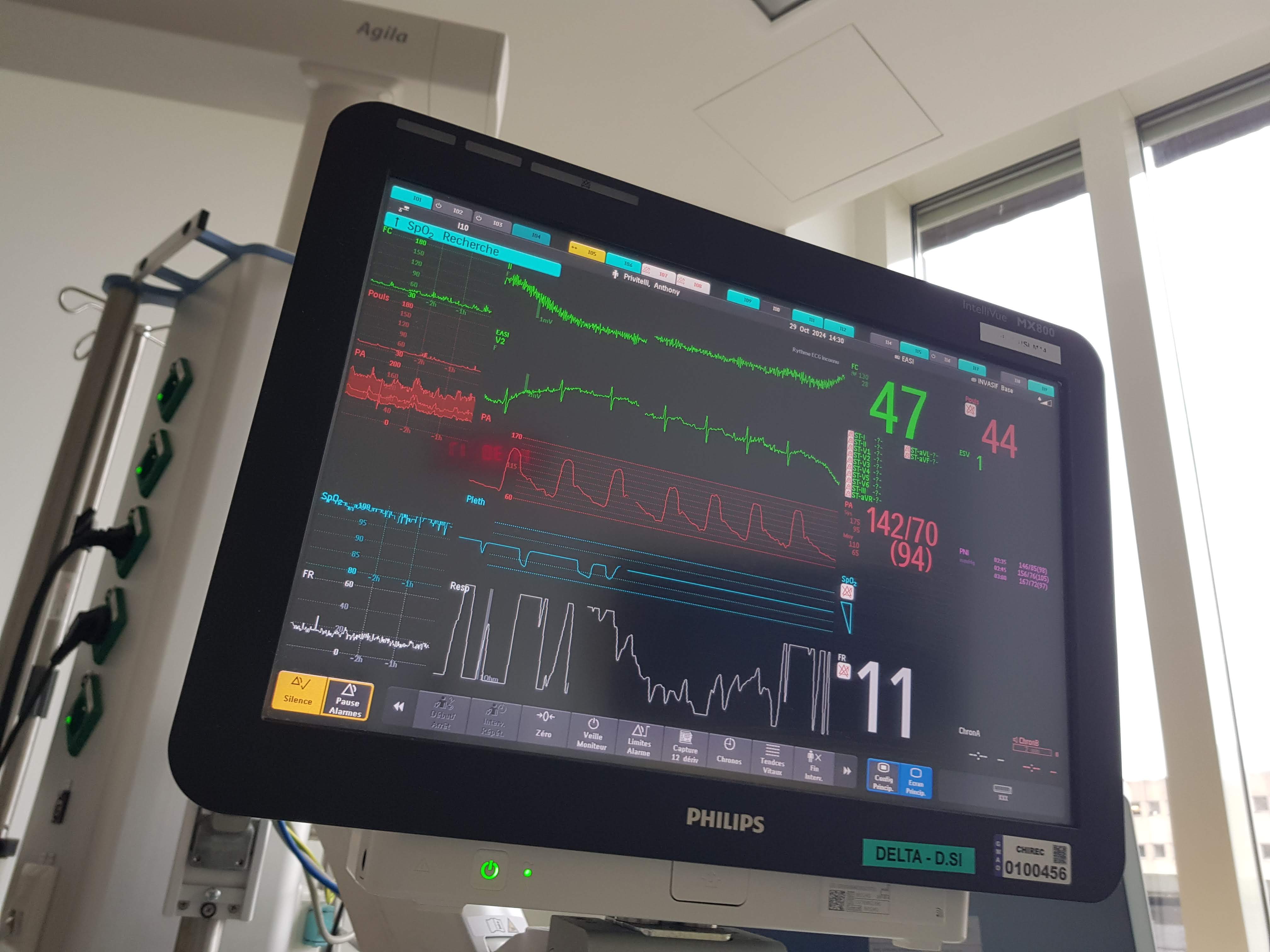
Things calmed down eventually and I slept a bit, somehow, tied down as I was. I had this keeping me company:

This was during the day and the rate had picked up somewhat. The night before it was generally in the 30s, sometimes dipping even into the 20s. There was a general consensus that I needed to get the pacemaker. This would happen the following day and there was nothing I could do about it.
So the following day they wheeled me into the operating theatre and put a pacemaker in my chest, turning me officially into a cyborg. Even while waiting at emergency, I had already discovered through the wonders of Google that with a pacemaker I could lead an almost normal life, even practise most sports, with some caution, although I had to keep a good distance from all sources of magnetism.


I have to say, what an experience. The staff at Chirec Delta hospital in Brussels were so kind, gentle, professional and patient. I can only say thank you to them. Also to so many friends and family members who expressed their concern and support. It was quite overwhelming.
So how do I feel now that I’m a cyborg? Well, I’m recovering, gradually. Still bewildered and getting to grips with it all, hoping I can get back to normality, travel and walk long distances. Concerned that this awful thing I can feel, all the time, like a weight on the left of my chest is going to remain there for the rest of my days. Maybe it will feel less obtrusive when I take away the plasters and the large bruise where I was operated goes down. But the thingy itself will remain inside and will be visible as a slight bump, says my doctor, unless I become obese in which case it will be disguised. Lovely. What I should consider, though, is that I may well be lucky to be alive and with a reasonable chance of staying active and well for a long time yet.
I mentioned earlier that I now have to avoid magnetic fields. If I get too close to a source of magnetism, this will interfere with the proper functioning of my pacemaker. Meaning I can’t wear headphones, can’t pass through the airport security gate, avoid keeping my smartphone too close to my chest and ideally replace the induction cooker at home… or stay well clear of it while stirring, using the back hobs and stirring the pot with right hand extended. That sort of bother – stay vigilant against sources of magnetism, all the time. I guess it will become second nature eventually. I suppose it’s a good thing I don’t have a magnetic personality…
The moral of the story is this: check your pulse every now and then. It may well save your life.
Leave a Reply